

I listened to the 11KBW Employment Podcast in which Katherine Taunton and Dan Stillitz KC discussed four recent cases on single-sex spaces: Peggie v NHS Fife and Beth Upton, Kelly v Leonardo UK Ltd, Hutchinson and Others v County Durham and Darlington NHS Foundation Trust in the employment tribunals, and Good Law Project v EHRC in the High Court.
Neutrality
Stilitz starts by warning that people feel strongly about this subject, and says that he and Taunton will set out the issues as comprehensively and fairly as possible. So it seems that the aspiration of the podcast is to provide neutral, non-partisan analysis. My view is that the podcast is strikingly and disappointingly partisan, and that is the aspect of it I will mostly focus on.
My own claim to neutrality is qualified. My personal position is rooted in the objective reality of sexed bodies, and therefore what has come to be called “gender-critical”. No doubt like everyone else on the planet I am prone to motivated reasoning, but I will always seek to comment candidly on the law as I understand it, irrespective of which side of this heated debate it serves.
In his introductory remarks, Stilitz says this subject is very complicated and difficult. In truth, the judgment of the Supreme Court in For Women Scotland is straightforward, and a model of clear, concrete reasoning. It holds that so far as the Equality Act 2010 is concerned, “trans women” are men, even if they have gender recognition certificates. What that means is that if you use an exception under the Act to provide something for one sex only, that has to mean biological sex; in general, you can’t run a single-sex space or service for women, and then admit members of the subcategory of men who have the protected characteristic of gender reassignment, because that won’t be a genuine use of a sex-based exception. The subject is only complex for those who are determined to find a way around the judgment of the Supreme Court. So that is the first strike against the podcast’s claimed neutrality.
The second comes hot on its heels. Stilitz speaks of the “well-known debate relating to trans rights and what are perceived to be the competing rights asserted by, in particular, gender critical feminists relating to single spaces in employers and in service providers”. He frames two things as being in opposition: “trans rights” on the one hand, which he simply refers to as rights without qualification; and on the other, something that takes many more words to name: “what are perceived to be the competing rights asserted by, in particular, gender critical feminists”.
So the claims of one side are simply “rights”; the claims of the other are only “perceived,” and apparently limited to a subcategory of people called “gender critical feminists”.
This is an odd framing. Politically, the argument that women are entitled to genuinely single-sex spaces is associated with gender critical feminism. But legally the argument is not that gender critical feminists have rights which are in tension with the claims of trans-identifying men, but that women — irrespective of their views on this issue — have rights on the basis of their sex which are in tension with the claims of trans-identifying men. (See what I did there? The things I regard as justified I called “rights”; the thing I regard as an abusive territory-grab I have called “claims”. The difference is that I know I’m doing it, and I have already said which side I’m on.)
Goodwin and the GRA 2004
Stilitz starts on his substantive analysis with Goodwin and the Gender Recognition Act 2004, which if not quite the very beginning is certainly a good enough place to start. He characterises the GRA as on its face giving trans people a very broad right to live in accordance with their acquired gender. That’s an ambitious reading of what is in reality more in the nature of a fancy kind of interpretation provision: the GRA tells us (with many express and we now know some rather important implied exceptions) what sex means in those fairly rare circumstances in which the law attaches consequences to whether someone is male or female. It doesn’t purport to give people who assert a cross-sex identity any positive rights to have other people participate in a wraparound pretence that they are indeed the opposite sex: if it did, the precise scope and nature of those rights would have to be carefully defined, enforcement mechanisms constructed, etc. It is also, to my mind, an over-ambitious reading of ¶91 of the judgment of the ECtHR in Goodwin; and if it is not, it is curious at any rate that there has never been a challenge to the adequacy of the GRA’s implementation of Goodwin.
For Women Scotland
Stilitz then says that the judgment in For Women Scotland had thrown what had been a fairly stable status quo into disarray. It is true that “Stonewall Law” had created a widespread and complacent misapprehension that the protected characteristic of gender reassignment operated as an access all areas pass. That exact argument was made by counsel for the appellant in Croft (more on that later). It was rejected. The finding of the Court of Appeal, whatever else may be said about obiter comments in the judgment, was that protection from gender reassignment discrimination does not confer an entitlement to access single-sex spaces.
That depended on the unsupported claim that the correct comparator to determine whether a trans-identifying man had suffered gender reassignment discrimination was a “non-trans woman”. That claim should have been laid to rest long ago by the judgment of the High Court in Green, but the myth had continued to be widely promulgated, accepted and, to the detriment of women, applied.
Stilitz then says this:
At various points in the judgment, the Supreme Court was at pains to say they weren’t cutting, cutting back trans rights. They weren’t purporting to rule on wider questions, in particular about single-sex spaces. Interestingly, in an interview with The Times in September 2025, Lord Hodge was very keen to, to try and clarify that point. He said that, “The case before the court involving Scotland had nothing to do with how or where single-sex spaces should be created. These points weren’t argued before us, we were not there to decide points that were not put to us or were not raised in the course of argument.”
But there is an important difference between what Lord Hodge said the court wasn’t purporting to rule on — how or where single-sex spaces should be created — and what Stilitz interprets that as meaning — wider questions, in particular about single-sex spaces. The judgment does not say when single-sex spaces should be created, no doubt because the Act doesn’t concern itself with that question, and the judgment is about the interpretation of the Act. But it is shot through with consideration of what the various permissions in the Act to create single-sex spaces and services mean; the unworkability of those permissions if sex is taken to mean “certificated sex” is central to the court’s reasoning. It is bizarre to suggest, as Stilitz does, that the judgment has nothing to say about how single-sex services and spaces can lawfully be operated: the judgment is clear that when the EqA permits single-sex provision, what it permits is single-sex provision on the basis of actual sex, not certificated sex.
Croft v Royal Mail
Stilitz then touches on Croft v Royal Mail, which he says “held in that case was that once one reached a certain stage of gender reassignment, the claimant was entitled to be treated as a woman, was entitled to use the women’s toilets”.
That is not what the Court of Appeal held in Croft. What the court held was that there was nothing unlawful about the employer’s refusal to permit a trans-identifying man to use the women’s facilities in the workplace in circumstances where he had only just embarked on his “transition”. It is true that the judgment proceeds on the basis that there will be a certain “stage of transition” (evidently meaning hormone treatment and/or surgery) at which a trans-identifying man “becomes a woman and entitled to the same facilities as other women .”
The Court of Appeal in Croft was having to work out for itself, before the GRA 2004 had been passed, what the legal consequences of “transition” might be in terms of access to opposite-sex facilities. Its answer was that pure self-identification was in any event not sufficient, although it anticipated that some degree (which it did not attempt to define) of medical and/or surgical modification would ultimately entitle an individual to access opposite-sex facilities. Before any other court had to attempt a definition of the “stage” of transition that would be requisite, parliament enacted a comprehensive regime for gender recognition in the GRA 2004, which (foreshadowing the judgment of the ECtHR in AP, Garçon and Nicot v France (Application Nos 79885/12, 52471/13 and 52596/13) (unreported) 6 April 2017) created a regime for legal recognition of “transition” that was not dependent on any medical or surgical preconditions beyond a diagnosis of dysphoria. As was perhaps not widely appreciated at the time, but is now clear from FWS, that regime did not provide the holders of gender recognition certificates with any right of access to opposite-sex facilities.
How, in these circumstances, it can be suggested that the judgment of the Court of Appeal in Croft is anything but a dead letter is a mystery.
The Darlington Nurses
I am instructed in both Kelly and Peggie, and both are under appeal to the Employment Appeal Tribunal, so I will leave others to comment on Stilitz’s analysis of those judgments, and skip to his discussion of the Darlington nurses case.
Stilitz begins his discussion of the Darlington case by noting that there was “a slightly unpleasant background” to the case in that rumours were circulating about whether or not Rose Henderson was “really a trans woman or not a trans woman in the full sense of the word.” Understandably, he doesn’t consider what it might mean for a man to be “really” a trans woman, or what exactly the “full sense of the word” might mean. What exactly is it to be “trans”? How might one distinguish even in theory between someone who is really trans, and someone who is only pretending? These are deep questions.
At ¶221, in its findings of fact, the tribunal records:
[The nurses] believed Rose to be a sexually active biological male, who had stopped taking hormones, had a female partner, and had made no secret of this or of plans to have a baby. There was a basis in fact for this belief. Rose had told colleagues about plans to have a baby, and Rose was not in fact taking hormones at the time.
Whatever it may or may not mean to be “genuinely” a trans woman, one might think that a deep-seated desire to be regarded and treated by others as a woman would be part of it. One might think, further, that whatever exactly the limits of the category “trans women,” it could be expected to exclude heterosexual men currently trying to get their wives or girlfriends pregnant. One might even think that the intelligence that a particular “trans woman” in the habit of using women’s changing rooms where his female colleagues undress is a sexually active heterosexual man might be thought quite reasonably to inform their fears — whether founded in fact or not — about his real reasons for wishing to use that space.
Apparently one would be wrong. Stilitz makes it clear that he regards these rumours “which frankly related to perhaps irrelevant aspects of Ms Henderson’s private life” as constituting unpleasant conduct on the part of the nurses, and he characterises their fears about his genuineness as “insinuations”.
So a heterosexual man who by his own admission (or boast) was currently trying to get his girlfriend pregnant said he was a “trans woman,” and on the strength of that claim was allowed to use the female nurses’ changing room at his workplace. Some of his female colleagues objected that his presence made them feel uncomfortable, and drew attention in explaining their discomfort to the fact that he is known to be trying to get his girlfriend pregnant. According to Stilitz, it is the female nurses in this story who have behaved intolerably.
Stilitz next discusses the delicate manoeuvre the tribunal performed to square its rejection of the nurses’ allegations of positive harassment of them (beyond the simple fact of his invasion of their changing room) with its finding that those allegations were made in good faith. Stilitz says:
[T]he tribunal found all of that was not right, that Rose hadn’t behaved improperly in any way. It has to be said, that being the finding, you’d have thought that the tribunal would take a pretty dim view that this slew of allegations [that] were brought. But instead, they found that nonetheless, the claimants’ discomfort and so on was genuinely held, and that there were reasons why they perceived Rose to have behaved in this way.
This is certainly a puzzle. The nurses had said that Henderson had paraded around the changing room in tight-fitting boxer shorts with holes in them, that he had spent longer than he needed to in the changing room, that he had initiated conversations with female colleagues there, that he stared at their breasts while they were getting changed. One of the nurses said that on one occasion he had asked her three times “are you not getting changed yet?”
The tribunal rejects most of those allegations as a matter of fact, although in relation to the last, it finds that Henderson asked the question at least twice. The judgment goes on (at ¶216):
We reject any suggestion, implicit or otherwise, that Rose asked this question for some sinister reason. Rose Henderson did not see themselves as a threat to any colleague and was simply getting changed when someone else arrived in the changing room, went to their locker yet did not start to get changed. It may be that Rose lacked insight generally into the effect of their presence in that environment on some colleagues. This lack of insight is partly explained, we infer, from Rose’s inherent belief that the right place for Rose to change was the female changing room; from the fact that Rose had been using the changing room for some time without complaint – or without being aware of any complaints…
Stilitz gives the impression that he considers the tribunal to have been unduly charitable to the claimants in finding that they had genuinely and sincerely believed the truth of their complaints, but in this passage the tribunal seems to be bending every nerve to give Henderson the benefit of the doubt. If a man whose employer has given him permission to use the women’s changing room notices that a female colleague he finds there appears to be hesitating to get changed, it really should not be asking too much of his powers of empathy to expect him to guess that she may be postponing getting changed because she is uncomfortable about his presence there. It might be thought odd and intrusive for a female user of that space to ask a colleague if she wasn’t getting changed yet, but much more so for a man to ask such a question.
Stilitz considers the tribunal’s finding that each claimant suffered “… a minimum level of distress caused by — at the very least — the apprehension that they may be exposed in their underwear to a biological male whilst changing” to be “quite a strong finding in that it was the apprehension of something rather than anything actually happened that gave rise to the harassment.” Stilitz no doubt unconsciously substitutes “minimal” (meaning very small) for the “minimum” (meaning at least) used by the tribunal; and his assessment of this as a “strong” finding seems to indicate that he thinks it unjustified.
This, when you think about it, is an odd view. Rose Henderson is a man. He is a man in every possible literal sense. He has an unmodified male body. He looks like a man, and as the tribunal finds at ¶212, he sounds like a man. He was at or around the time of the alleged harassment trying to get his girlfriend pregnant. And FWS tells us that even if he had a gender recognition certificate (which there was no suggestion he did), so far as the EqA is concerned he would legally be a man too. But for the detail that he had uttered the performative words “I am a woman” and thereby gained the Trust’s permission to use the women’s changing room, there was nothing to distinguish him from any other male employee of the Trust. Presumably Stilitz would agree that for a man who had not uttered those words, entering the women’s changing room would be a clear violation of their privacy and an act of harassment. It is difficult to understand why he would think that the incantation “I am a woman” makes the violation insignificant.
But Stilitz is by no means the first sophisticated, thoughtful, clever lawyer to struggle to understand that a man in a women’s changing room is inherently abusive even when that man says he is a woman, so there is something going on here. My best guess (and we’re in the realm of psychology, not law, so anyone’s guess is as good as mine) is that it’s what psychologists call the “repetition effect” and propagandists know well: repeat any lie often enough and loud enough, and people will start to believe it.
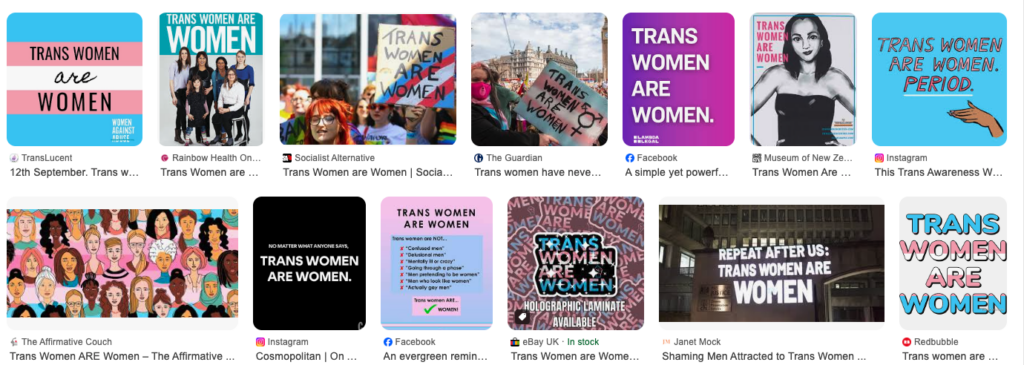
The lie in question is that some men (those sometimes called “trans women”) are women. It is certainly repeated with great regularity and insistence. My suspicion is that this particular lie has a superpower. Because it consists in a claim that some people are not the sex they are, it becomes impossible to speak of those people without either rejecting or assenting to and reinforcing the lie in the pronouns by which you refer to them. The reason it has been so determinedly made taboo to refer to trans-identifying men by masculine pronouns is that feminine pronouns serve as a compelling method of reinforcing the lie with every utterance about such a person, and of co-opting bystanders (and often even dissenters) into active collusion in their own brainwashing.
I believe this is most if not the whole of the reason why pronouns are such a bitterly fought-over frontier in the gender wars. Language compliance is one of the most powerful methods by which the lie is propagated. Defying the pronoun taboo serves as an intolerable drum-beat of resistance, and of insistence that the emperor has no clothes. It undermines the lie.
Moving on to indirect discrimination, Stilitz says the analysis of the indirect discrimination claim in the Darlington case was “broad brush,” but since he doesn’t give particulars of any specific respects in which he thinks it mistaken or inadequate, his own analysis might be said to be guilty of the same fault.
Stilitz is then very gently pressed by his interlocutor on the podcast, Katherine Taunton, on whether the fact that Henderson was known to be trying to get his girlfriend pregnant might have swayed the tribunal. He says “It has to be said, though, in one sense, the detail of Rose Henderson’s private life and relationship and plans for family and so on, one would have thought ought to be irrelevant to her treatment in the workplace,” and he goes on to point out the breadth of the protected characteristic of gender reassignment. It is certainly true that it is broad, and comfortably capable of including a man who proposes to undergo a process of gender reassignment (whether or not involving surgery) at some point in the future after he has fathered a family. But it really should not be hard to spot that the breadth of the protected characteristic is not a reason why men who possess it should be admitted to women-only spaces. On the contrary, that breadth is a reason why the protected characteristic of gender reassignment should not be treated as an access-all-areas pass to women’s spaces.
Something else Stilitz feels has to be said in this context is that “if one were looking at a different protected characteristic, one wonders whether they’d have been given quite such a sympathetic hearing as to their concerns in circumstances where it was found that Rose herself had done nothing wrong.”
This is worth some unpacking. What does Stilitz mean, exactly, about a “different protected characteristic”? I suspect it goes something like this. Suppose a group of nurses had complained of the use of their changing room by a black nurse, or a lesbian nurse? Suppose because of their racist or homophobic prejudices they had harboured suspicions about their colleague staring at them, or acting aggressively towards them, etc? The implication is that the nurses’ objection to Henderson’s use of the women’s changing room was rooted in his protected characteristic of gender reassignment, and in objecting they were displaying bigotry of a kind the tribunal should have shown no patience for.
Once unpacked, it falls apart. That’s because the nurses were not objecting to Henderson’s presence in the women’s changing room because of his gender reassignment, but because of his sex. They had been provided with what they were told was a women-only space in which to change for work, and then their employer had permitted a male colleague to use it. There is nothing in the tribunal’s findings to suggest that they would have had less objection to a male colleague without the protected characteristic of gender reassignment using it, and it’s fanciful to imagine they might have. So their objection could only be characterised as born of bigotry if it was bigoted of them to want a women-only changing room in the first place. Of course it wasn’t. Their employer acknowledged that by purporting to provide it, and the 1992 regulations acknowledge it by making it mandatory.
Perhaps more than any other observation, this flawed comparison to other protected characteristics discloses why this podcast was always going to fail its aspiration to neutrality. Stilitz’s blow could only land if the legal position were that “transwomen are women,” and the nurses were objecting to the presence of a particular subcategory of women, “trans women.” Whether Stilitz knows it or not, this is straight out of the trans activist playbook. It is the whole reason why activists are so keen on the space between “trans” and “woman,” because that gives the impression that the noun “woman” is qualified by the adjective “trans,” and lays the foundation for the false equivalence between objecting to men in a women’s changing room, and objecting to the presence of (genuine) subcategories of women there. Stilitz is following in the footsteps of the authors of A practical guide to Transgender Law (Law Brief Publishing, 2021, which I reviewed here), who said:
The EqA 2010 definition of ‘man’ is a male of any age and ‘woman’ is a female of any age’ (EqA s212). But without a definition of ‘male’ and ‘female’ this does not help. Is a trans male a male or a trans woman female? Is a trans woman something different from a woman? But a gay woman or a black woman are still women, why not a trans woman?
Stilitz is entitled to believe men who say that they are women, and that wider society should treat them as such, and that the law ought to compel this. But it is incorrect to proceed from that position as if it were either neutral or an accurate statement of the law.
Taunton then suggests that the number of nurses who were raising complaints about Henderson’s use of the women’s changing room may also have influenced the tribunal in finding for them. Stilitz in his answer speculates that if trans-identifying men are excluded from women’s spaces, they might have claims for indirect or even direct discrimination because of gender reassignment. He says they probably would have indirect discrimination claims “because effectively they’re being stopped from using or from living in accordance with their lived gender”. He does not address the question of justification, which is curious, since this is the battle-ground on which any such claim would be most likely to be fought.
It is also the basis on which any employer operating such a rule would be likely to defeat an indirect discrimination claim with ease, by reference to their obligations under the 1992 regulations. How could it possibly be said not to be a proportionate means of achieving a legitimate aim for an employer to do something which it is obliged by regulations to do?
But the suggestion that trans-identifying men might have a direct discrimination claim is even more surprising. Stilitz goes on:
if one applies Croft v Royal Mail, certainly in the case of trans people who have undergone a process of gender reassignment, arguably then the appropriate comparator is a cis person of the same lived gender as them.
The word “cis” is activist language, and should be surprising from a commentator who aspires to be seen as impartial. And as to the substance, it is difficult to see how that is arguable, after the short work of the suggestion made by the High Court in Green; and more especially in light of ¶134 of For Women Scotland:
Where gender reassignment is the protected characteristic, in the case of a male person proposing to or undergoing gender reassignment to the opposite sex, the correct comparator is likely to be a man without the protected characteristic of gender reassignment and similarly for a woman (although there may be situations where the comparators sex is immaterial to the comparison)
That is an inevitable corollary of the core holding of FWS, namely that a gender recognition certificate does not change a person’s sex for the purposes of the EqA. A comparator is someone who is like the putative victim of discrimination in all material respects apart from his or her protected characteristic. So the comparator needed to determine whether a man with the protected characteristic of gender reassignment has suffered gender reassignment discrimination is a man without the protected characteristic of gender reassignment.
The throwaway qualification “certainly in the case of trans people who have undergone a process of gender reassignment” appears to imply that Stilitz thinks that even after FWS there may be some category of trans people whose “transition” is so complete that they are entitled to be regarded as having changed sex. This feels like a throwback to Lord Bingham’s “visually and for all practical purposes indistinguishable” test in Chief Constable of the West Yorkshire Police v A (No 2) [2004] ICR 806.
I have two points to make about this test. The first is a reminder of the legal position: it was superseded more than 20 years ago by the GRA 2004.
The second is more visceral.
“Visually and for all practical purposes indistinguishable.” Let’s think about that for a moment, shall we? What exactly are these practical purposes of the differences between men and women? Stilitz appears to be echoing Lord Bingham’s unthinking confidence that surgery can turn a man into someone who is for all practical purposes a woman.
The most obvious practical purpose of the difference between men and women (presumably we’re not talking jar-opening) is sex and procreation. It is true that a man can have testicles removed and his penis flayed and inverted to line a surgical cavity roughly where you would find a vagina in a woman. The result is a surgical wound that will naturally try to heal, and must be kept open by regular dilation. This wound, one might think it need hardly be said, is not a vagina. It is a dead-end, unconnected to any female reproductive equipment. It will not self-lubricate in response to sexual arousal, nor will it contract on orgasm (supposing anything approaching even male orgasm is left to a man who has had this surgery). Any sperm ejaculated there will search in vain for an egg to fertilise.
Anyone who imagines that the construction of such a cavity between a man’s legs makes him a woman would appear to equate womanhood with the presence of an accommodating hole into which another man may ejaculate. On that measure, a blow-up doll is a woman. I am not quite sure how to do justice in words to how insulting and morally repugnant I find this proposition.
But it is not just insulting and morally repugnant. It is also not the law. This was the question considered in Corbett v Corbett [1970] 2 All ER 33, in which the court ruled that so far as the common law was concerned, sex was fixed at birth and could not be changed by surgery. That approach was affirmed in Bellinger v Bellinger [2003] AC 467 and A v Chief Constable of West Yorkshire Police [2005] 1 AC 51. (For an extended discussion of these cases, see Foran, M. (2025), Defining sex in law. Law Quarterly Review, 141, 76–103.) A regime for legal recognition of a change of sex from male to female or female to male was then authoritatively and exhaustively defined by the GRA in 2004, and the limits of that were authoritatively interpreted by the Supreme Court in 2025. There is no scope now for revisiting the arguments in Corbett v Corbett and seeking to revive a claim that if a man has sufficiently extreme cosmetic surgery, he will become a woman. Once again, it is surprising to hear a lawyer of Stilitz’s undoubted distinction make the attempt, even in a throwaway aside in a long podcast.
Conclusion
I will end where I started, with the question of neutrality.
Stilitz uncritically uses activist language, referring to men who say they are women as “she” and those who do not claim a gender identity at odds with reality as “cis”. He frames the conflict as one between unqualified “trans rights” on the one hand and “what are perceived to be the competing rights asserted by… gender critical feminists” on the other. He betrays a disdain for the female claimants in the Darlington case, whom he frames as guilty of a kind of bigotry that would be less charitably treated if it were focused on a different protected characteristic (by which he also implies that the tribunal was “transphobic” in its indulgence of them).
But most worryingly, as I hope I have shown above, his legal analysis is repeatedly flawed; and flawed every single time in a way calculated to maximise the claims of trans-identifying men and sideline the concerns of women.
This is men’s rights activism dressed up as legal analysis. It does no credit to the (usually excellent) 11KBW employment podcast.